Diese Veranstaltung ist bereits beendet.
George Legrady- Refraction
Opening: September 7th, 6-9 pm
Exhibition: September 8th - October 13th, 2012
Nature Morte Berlin is pleased to announce George Legrady’s first solo exhibition at the gallery. A leading
figure in the realm of media art, George Legrady has created some of the most fascinating multimedia
installations, data visualization projects and photography of the past twenty years. In his ongoing research
into the semiotics of photography, socio-cultural narrative, interactivity and computational technologies,
Legrady pushes and manipulates cutting edge technology to produce astonishingly subtle results that
question our relationship with technology.
At Nature Morte Berlin the artist will present a new body of work, consisting of 8 lenticular photographic
panels, a computer animation and a multimedia installation.
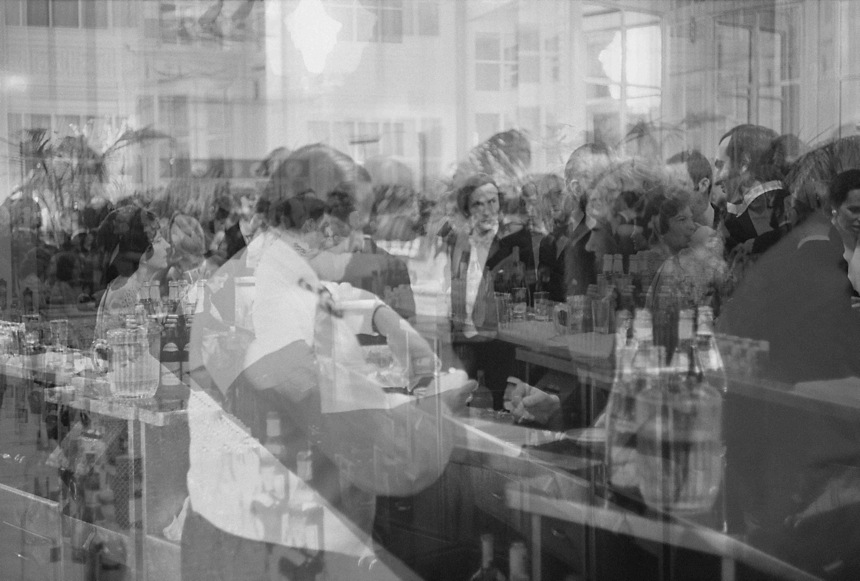
The work Refraction consists of 8 composite photographs, printed with the lenticular process which
superimposes three images each becoming visible based on the spectator’s angle of view. Legrady
rediscovered a series of documentary photographs he took in 1973 of the annual Hungarian gala ball in
Montreal and was fascinated by their cinematic and seemingly staged quality. Legrady, who is more known
for his use of cutting edge technology, appropriated the lenticular process (a retro printing method used in
popular culture as early as 1940) to forge a dialogue between photography and cinema. By physically
involving the audience as their movement determines the transition of the images, Legrady allows the
spectator to be complicit in the timing and meaning of the work.
Continuing his exploration of perceptional transitions, Slice, a software-generated animation investigates
the fine line between recognition and abstraction by slicing an image into smaller and smaller sections until
the legible image turns into an illegible abstraction. Once reduced to this state, the image sequencely
rebuilds itself but into another image.
The exhibition also includes a 4 channel audio-visual composition Voice of Sisyphus. This work is
comprised of a black and white projected photograph from the Hungarian Ball, which is analyzed by
software, and sonified and spatialized through a four-channel audio system. Using a highly complex
synthesis technique, the composition unfolds as several regions within the image are filtered, subdivided,
and repositioned over time.
George Legrady was born in 1950 in Budapest and raised in Montreal. He received his MFA from the San
Francisco Art Institute and has been a professor of interactive media arts at the University of California at
Santa Barbara since 2001. His work has been exhibited at a number of prestigious institutions including the
Whitney Museum of American Art in New York, the Centre Pompidou in Paris, Zentrum fur Kunst und
Medientechnologie (ZKM) in Karlsruhe, and the SOMArts Center in San Francisco. The works in Refraction
were first exhibited at Edward Cella Art + Architecture in Los Angeles in 2011.
---
George Legrady - Refraction
Vernissage am 7. September, von 18 bis 21 Uhr
Die Ausstellung läuft bis zum 13. Oktober 2012
Nature Morte Berlin freut sich George Legradys erste Einzelausstellung in der Galerie anzukündigen. George
Legrady ist einer der führenden Künstler im Bereich der Medienkunst und hat einige der faszinierendsten
Multimediainstallationen, Datenvisualisierungsprojekte und Fotografien der letzten zwanzig Jahre kreiert. In
seiner kontinuierlichen Erforschung fotografischer Semiotik, soziokultureller Narrativen, Interaktivität und
Computertechnologien manipuliert Legrady modernste Technologie, bringt sie an ihre Grenzen und erzielt
dadurch erstaunlich subtile Resultate, die unser Verhältnis zur Technologie hinterfragen.
In der Ausstellung Refraction präsentiert der Künstler eine neue Werkgruppe, die aus acht, mit der
Linsenrastertechnik hergestellten Fotopanelen, einer Computeranimation und einer Multimediainstallation
besteht.
Die Arbeit Refraction besteht aus acht zusammengesetzten Fotografien, die mit dem Linsenrastersystem
hergestellt sind. Bei dieser Retrodruckmethode, die schon seit 1940 in der Popkultur Verwendung findet,
werden drei Bilder so übereinander projiziert, dass die Sichtbarkeit eines Bildes jeweils vom Blickwinkel des
Betrachters abhängt. Legrady entdeckte eine Reihe dokumentarischer Fotografien wieder, die er 1973 vom
alljährlichen ungarischen Galaball in Montreal gemacht hatte, und war fasziniert von ihrer filmischen,
scheinbar inszenierten Qualität. Legrady, der bekannter ist für seine Verwendung modernster Technologie,
machte sich das Linsenrastersystem zu eigen um die Fotografie in einen Dialog mit dem Kino zu setzen.
Durch die körperliche Einbindung des Publikums, dessen Bewegungen die Überblendung der Bilder
bestimmen, ermöglicht Legrady dem Zuschauer am Ablauf und dadurch auch an der Bedeutung der Arbeit
teilzuhaben.
Slice, eine softwaregenerierte Animation, führt seine Erkundung von Wahrnehmungsübergängen fort und
erforscht den schmalen Grat zwischen Erkenntnis und Abstraktion. Dabei wird ein Bild in immer kleinere
Teile zerschnitten bis sich das verständliche Bild in eine unverständliche Abstraktion verwandelt hat. Einmal
in diesen Zustand reduziert, baut sich das Bild sequenziell wieder auf, allerdings in ein anderes Bild.
Die Ausstellung enthält auch eine vierkanalige audiovisuelle Komposition, mit dem Titel Voice of Sisyphus.
Die Arbeit besteht aus einer schwarzweiß projizierten Fotografie des ungarischen Balls, welche von Software
analysiert und durch ein vierkanaliges Audiosystem vertont und verräumlicht wird. Durch die Anwendung
einer hochkomplizierten Synthetisierungstechnik entfaltet sich die Komposition indem mehrere Regionen
innerhalb des Bildes nach und nach gefiltert, unterteilt, und neu positioniert werden.
George Legrady wurde 1950 in Budapest geboren und wuchs in Montreal auf. Er erhielt einen MFA vom San
Francisco Art Institute und ist seit 2001 Professor für Interaktive Medienkunst an der Universität von
Kalifornien, Santa Barbara. Seine Arbeiten wurden in einer Vielzahl renommierter Institutionen ausgestellt,
unter anderem im Whitney Museum of American Art in New York, dem Centre Pompidou in Paris, dem
Zentrum für Kunst und Medientechnologie (ZKM) in Karlsruhe und im SOMArts Center in San Francisco. Die
Arbeiten in Refraction wurden zuerst 2011 bei Edward Cella Art + Architecture in Los Angeles gezeigt.