Diese Veranstaltung ist bereits beendet.
Nature Morte freut sich “Radiant Lines“, eine
Einzelausstellung mit neuen Arbeiten von Seher
Shah, anzukündigen. Mit ihrem Hintergrund in
bildender Kunst und Architektur ist Seher Shah
dafür bekannt verschiedene architektonische,
historische und persönliche Ikonographien in
überwiegend monochromen Arbeiten zu
verflechten. Die Ausstellung zeigt Zeichnungen,
Drucke und Foto-Leuchtkästen und setzt Shahs
Erkundung idealisierter Projekte der Moderne fort.
Shah erforscht sowohl die formellen als auch die
viszeralen Eigenschaften brutalistischer
Architektur in deren Verhältnis zur Landschaft.
Der Titel der Ausstellung stammt von Le
Corbusiers Konzeption La Ville Radieuse, die
leuchtende Stadt, ein Konzept, welches er in den
30er Jahren zu entwickeln begann und dass seine
Kernideen zur Umgestaltung der Gesellschaft
durch eine modernistische Städteplanung enthält.
Die bekanntesten Ville Radieuse-Projekte,
allesamt utopisch im Wesen und sozialistisch im
Anspruch, sind die Unité dʼHabitation- eine Reihe
modernistischer Sozialbauten in Frankreich und
Deutschland- und Chandigarh, die Hauptstadt der
nordindischen Staaten Punjab und Haryana,
welche Le Corbusier in ihrer Gesamtheit entwarf.
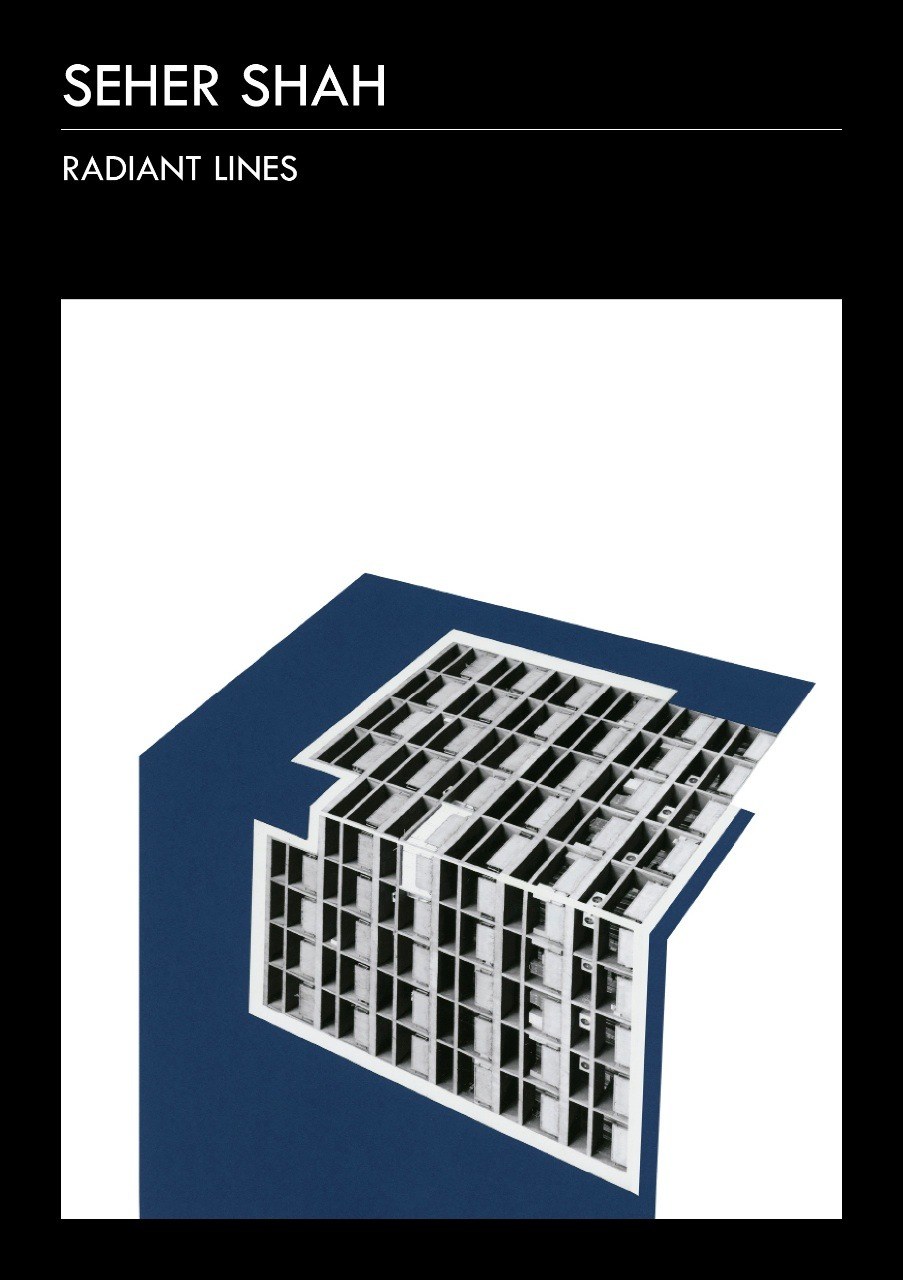
Der Großteil der Arbeiten in Radiant Lines erinnert
an die bausteinförmigen Fassaden von Le
Corbusiers Unité dʼHabitation in Marseille. In der
Reihe Unit Object Drawings (2012) unterteilt
Seher Shah das Raster der Fassade in seine
verschiedenen strukturellen Komponenten und
durchkreuzt es mit harten geometrischen Formen.
Die Struktur der Fassade wird erweitert und
ergießt sich in minutiösen Zeichnungen. Die
Wiederholung der Form produziert eine gewisse
Zweideutigkeit, bei der man sich nie sicher ist, ob
man verschiedene Einzelobjekte oder nur ein
Objekt aus verschiedenen Perspektiven
betrachtet. Die vierteilige Zeichnung Study for a
Totem (2012) greift wiederum das kartesische
Fassadenraster auf und zeigt ein einzelnes
modernistisches Objekt ohne dessen
landschaftlichen Kontext. In diesem spezifischen
Werk erscheint die Brutalität der Objektform in
krassem Kontrast zur Feinheit und
Detailgenauigkeit der Zeichnung. Durch das
Anwenden grundlegender architektonischer
Elemente- Mauer, Raster, Säule- arbeitet sich
Seher Shah an Konzepten der Konstruktion und
der strukturellen Repitition ab. Sie isoliert und
hebt die hart-konturierten, autoritär
monumentalen Formen und Strukturen hervor,
und macht uns damit, in subtiler Weise, auf die
Auswirkungen aufmerksam, welche diese
brutalistisch arrangierten urbanen Orte auf
unseren Lebensraum haben.
Zusätzlich zu diesen Arbeiten wird in der
Ausstellung auch Shahs Leuchtkastenreihe
Hinterland Structures (2011) zu sehen sein. Die
Fotoserie enstand während einer Reise durch den
Westen Amerikas und zeigt vereinzelte
Containerstrukturen, wie z.B. industrielle
Bauhütten, Wohnwagen und Silos in einer
ansonsten unbebauten Landschaft.
Die Reihe Mammoth: Aerial Landscape Proposals
(2012) zeigt Luftaufnahmen von Landschaften
(fotografiert von Randhir Sing), die von
verschieden großen Strukturen durchsetzt sind.
Seher Shah wurde 1975 in Karachi geboren und
wuchs in London, Brüssel und New York auf. 1998
erhielt sie einen Bachelor of Fine Arts und einen
Bachelor of Architecture von der Rhode Island
School of Design. Zu ihren Einzelausstellungen
gehören, unter anderem, Object Anxiety im
Scaramouche, New York, Paper to Monument,
Nature Morte, New Delhi, Brute Ornament in der
Green Art Gallery, Lines of Control im Herbert F.
Johnson Museum of Art, On Rage im Haus der
Kulturen der Welt, Berlin, Eccentric Architecture
und Generation 1. 5, Queens Museum of Art,
Drawing Space bei Green Cardamom, New York to
Los Angeles bei GBK, Sydney und Zeichnungen:
conceptual and concrete drawings in der Gisele
Linder Gallerie, Basel. Ihre Arbeiten befinden sich,
unter anderem, in den Sammlungen des Museum
of Modern Art, New York, des Brooklyn Museum,
des Queens Museum of Art, des Museum of
Contemporary Art in Schaffhausen, Schweiz, der
Devi Art Foundation, der Deutsche Bank Art
Contemporary, der Progressive Art Kollektion und
der Thyssen-Bornemisza Art Contemporary
Foundation, Wien, Österreich (T-B-A21). Seher
Shah lebt und arbeitet in Brooklyn, New York.
------
Nature Morte is pleased to announce Radiant
Lines, a solo show of new works by Seher Shah.
With a background in both Fine Arts and
Architecture Shah is known for weaving together
different architectural, historical and personal
iconographies in largely monochromatic works.
The exhibition comprises drawings, prints and
photographic light boxes, continuing her
investigation into idealized modernist projects
and exploration of the formal and visceral
qualities of Brutalist architecture in its
relationship to landscape.
The show takes its title from Le Cobusier's
concept of La Ville Radieuse, The Radiant City, a
concept he developed from the 1930ʼs onwards
and which encapsulates his ideas of reforming
society through his modernist approaches to
town planning. Fundamentally utopian and
socialist in their ambition, the most prominent
Radiant City projects are Unité dʼHabitation – a
variety of modernist social housing units in
France and Germany – and Chandigarh, the
capital of the northern Indian states Punjab and
Haryana, which Le Cobusier planned in its
entirety.
The main body of work in Radiant Lines recalls
the modular facade of Le Cobusierʼs Unité dʼ
Habitation of Marseille. In the series Unit Object
Drawings (2012) Seher Shah breaks the facadeʼs
grid into its different structural components and
intersects it with solid geometric shapes. The
structure of the facade expands and unfolds in
the delicate drawings and the repetition of form
creates an ambiguity as to whether one is looking
at separate objects or in fact at one object from
various perspectives. The four-part drawing Study
for a Totem (2012) again uses the Cartesian grid
of the facade and depicts a single modernist
object without the context of a landscape. In this
particular work the brutality of the objectʼs shape
appears in harsh contrast to the delicacy and
detail of the drawing. Using the basic elements of
architecture – wall, grid and column – Seher Shah
works through concepts of construction and
structural repetition. By isolating and highlighting
the hard-shaped authoritarian and monumental
forms and structures, Shah subtly points us
towards the effect these brutalist engineered
urban spaces have on our habitat.
In addition to these works the exhibition will
feature Shah's light box series Hinterland
Structures (2011), consisting of photographs
taken from a trip to the American West that depict
a variety of container structures such as industrial
sheds, trailers and silos; objects disconnected
from the landscape surrounding them.
The series Mammoth: Aerial Landscape Proposals
(2012) are aerial landscape photographs (taken by
Randhir Singh) intersected with ambiguous
structures in mass and scale.
Born 1975 in Karachi, Pakistan, Seher Shah grew
up in London, Brussels, and New York. She
received her Bachelor of Fine Arts and Bachelor of
Architecture from the Rhode Island School of
Design in 1998. Select recent exhibitions include
Object Anxiety at Scaramouche, New York (solo);
Paper to Monument, Nature Morte, New Delhi
(solo); Brute Ornament at the Green Art Gallery,
Dubai; Lines of Control at the Herbert F. Johnson
Museum of Art, New York; On Rage at the Haus
der Kulturen der Welt, Berlin; Eccentric
Architecture and Generation 1. 5, Queens
Museum of Art, New York; Drawing Space at
Green Cardamom, London; New York to Los
Angeles at GBK, Sydney; and Zeichnungen:
conceptual and concrete drawings at the Gisele
Linder Gallery, Basel. Her work is in the
collections of the Museum of Modern Art, New
York, The Brooklyn Museum, The Queens Museum
of Art, Museum of Contemporary Art in
Schaffhausen, Switzerland, Devi Art Foundation,
New Delhi, Deutsche Bank Art Contemporary, and
the Thyssen-Bornemisza Art Contemporary
Foundation, Vienna, Austria (T-B-A21), amongst
others. Seher Shah lives and works in Brooklyn,
New York.